
What Is a Verb? | Definition, Types & Examples
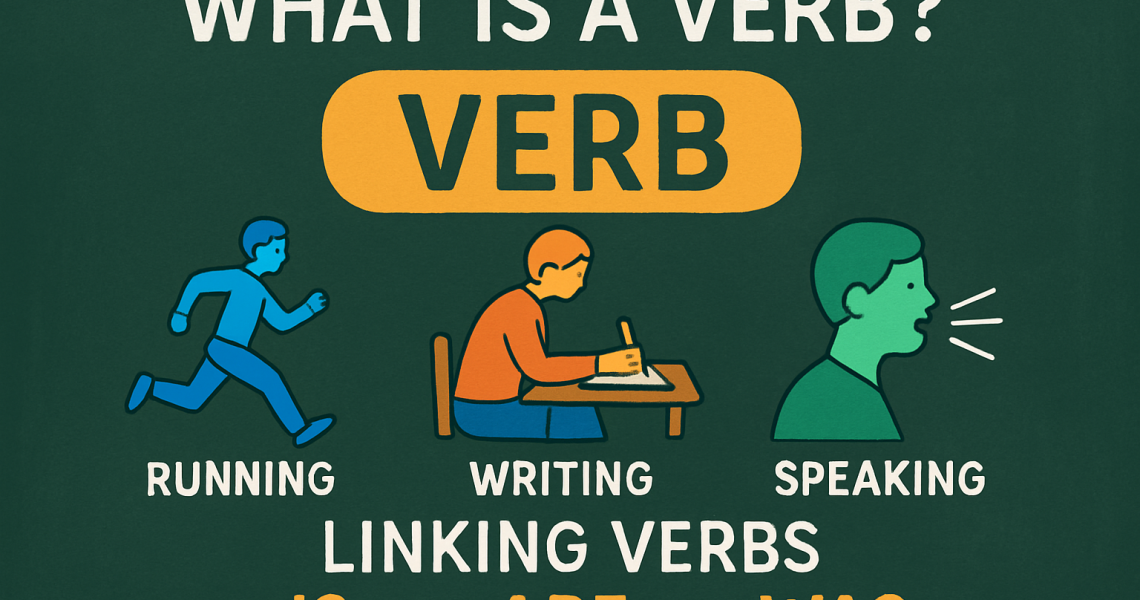
A verb is one of the most important parts of speech in the English language. Whether you’re writing, speaking, or learning English grammar, understanding verbs helps you create clear and meaningful sentences. In simple terms, a verb is a word that expresses an action, an event, or a state of being.
In this blog post, we’ll explain what verbs are, why they are important, different types of verbs, and how to use them correctly. You’ll also find plenty of examples that make learning easy for beginners and English learners.
What Is a Verb? (Definition)
A verb is a word that tells us what the subject of a sentence does, is, or experiences.
✔ Simple Definition:
A verb is a word that shows:
-
Action (run, eat, drive)
-
State of being (am, is, are)
-
Occurrence (happen, occur, develop)
✔ Examples:
-
She runs every morning. (action)
-
They are happy. (state)
-
A new idea developed in his mind. (occurrence)
Verbs are necessary because every sentence must have at least one verb.
Why Are Verbs Important?
Verbs:
-
Give meaning to sentences
-
Show tense (past, present, future)
-
Help express mood or intention
-
Connect subjects to actions
Without verbs, communication becomes incomplete. For example:
❌ “He football yesterday.”
✔ “He played football yesterday.”
Types of Verbs (With Examples)
English has several types of verbs. Understanding each type makes grammar easier to master.
1. Action Verbs
Action verbs show what someone or something does.
✔ Examples:
-
He writes stories.
-
They play cricket.
-
The dog runs fast.
Action verbs can be:
-
Physical actions – jump, walk, cook
-
Mental actions – think, decide, imagine
2. Linking Verbs
These verbs connect the subject to additional information but do not show action.
Common linking verbs:
-
am, is, are
-
was, were
-
become, seem, feel, appear
✔ Examples:
-
She is a doctor.
-
The food smells delicious.
-
They were tired.
3. Helping (Auxiliary) Verbs
Helping verbs are used + main verbs to show tense, mood, or voice.
Common helping verbs:
-
am, is, are
-
was, were
-
have, has, had
-
do, does, did
-
can, could
-
will, would
-
may, might, must
✔ Examples:
-
They are playing chess.
-
She has finished her work.
-
He will go tomorrow.
4. Transitive Verbs
These verbs require an object to complete their meaning.
✔ Examples:
-
They bought a car.
-
She reads books.
-
He drinks water.
Without the object, the sentence is incomplete.
5. Intransitive Verbs
These verbs do not require an object.
✔ Examples:
-
He smiled.
-
They arrived early.
-
The baby cried.
The meaning is complete without an object.
6. Regular Verbs
Regular verbs follow the -ed rule in past tense.
✔ Examples:
-
walk → walked
-
play → played
-
open → opened
7. Irregular Verbs
Irregular verbs do not follow the regular -ed pattern.
✔ Examples:
-
go → went
-
eat → ate
-
see → saw
-
write → wrote
These must be memorized.
8. Modal Verbs
These verbs express ability, permission, necessity, or possibility.
Common modal verbs:
-
can, could
-
may, might
-
must, should
-
will, would
✔ Examples:
-
You must study hard.
-
He can swim.
-
They might come later.
9. Phrasal Verbs
A phrasal verb = verb + preposition/adverb, giving a new meaning.
✔ Examples:
-
look after (take care of)
-
give up (quit)
-
take off (remove / depart)
-
turn on (switch on)
Example sentences:
-
She gave up smoking.
-
Please turn on the lights.
Verb Tenses (Brief Overview)
Verbs change form to show when an action happens. The three main tenses are:
✔ Present tense
-
I work.
✔ Past tense
-
I worked.
✔ Future tense
-
I will work.
Each tense has four forms: simple, continuous, perfect, and perfect continuous.
Examples of Verbs in Sentences
-
The cat slept on the couch.
-
They will visit the museum tomorrow.
-
She is learning English.
-
He has eaten breakfast already.
-
The flowers smell nice.
How to Identify a Verb in a Sentence
Ask these questions:
-
What is the subject doing?
-
Is the word showing an action, state, or event?
-
Can it change tense (walk, walked, walking)?
If yes → it’s a verb.
Common Mistakes Learners Make With Verbs
❌ Using wrong verb form
✔ She goes to school. (Not: She go to school.)
❌ Confusing regular and irregular verbs
✔ They ran fast. (Not: runned)
❌ Missing helping verbs
✔ He is playing football. (Not: He playing football.)
A verb is the heart of a sentence. It tells us what the subject does, is, or experiences. By learning the types of verbs—action, linking, helping, transitive, intransitive, regular, irregular, modal, and phrasal—learners can improve their grammar, writing, and speaking skills.
Understanding verbs makes English clearer, more accurate, and more powerful.